

Air Conditioning & Attachment Issues
The kind that presses itself against your skin and asks you to stay a little too long.

I’m a little embarrassed to admit this, but lately I’ve been showing early signs of hobosexuality. Not the full-blown, move-into-your-lover’s-loft variety—but something quieter, more existential. I’ve just moved into a new old house, and it still doesn’t feel like mine. I wander through its rooms like a frantic character beginning her unraveling.
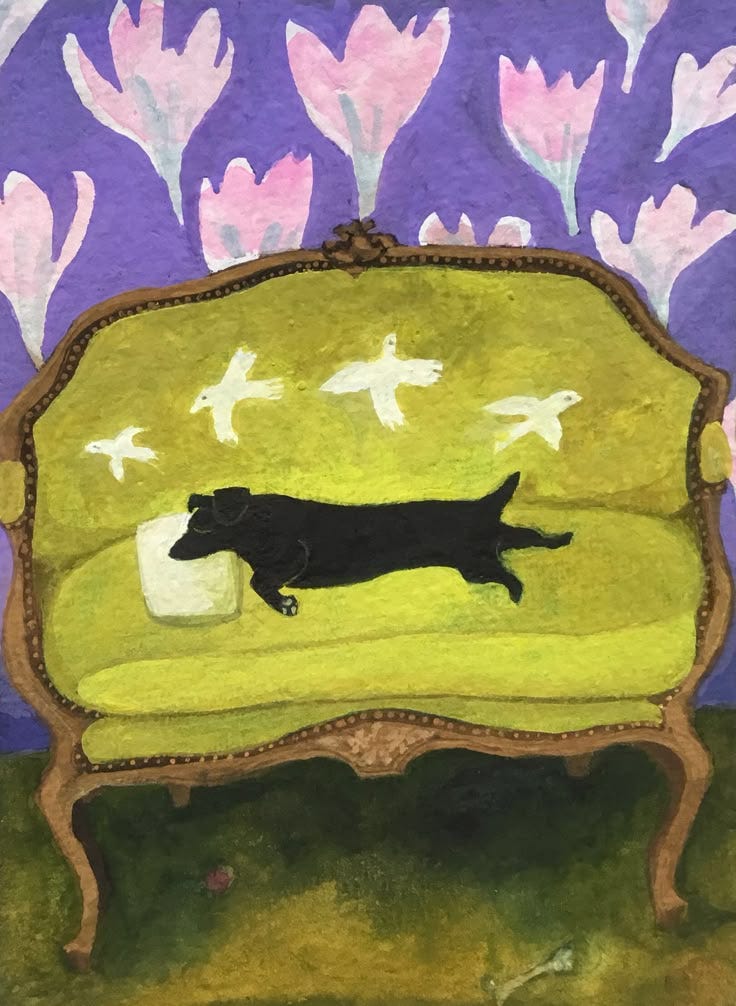
By definition, a hobosexual is someone who enters into romantic or sexual relationships not out of affection, but necessity, seeking shelter, support, the soft architecture of another’s life to rest inside.
And while I haven't weaponized love for housing, I’ve been orbiting its shadows.
Key characteristics of a hobosexual:
Expedites intimacy for shelter, not soul. The connection feels urgent—but it's not love that knocks, it’s logistics. They arrive not to know you, but to stay warm.
Mimics devotion with survival as subtext. The gestures are familiar, even tender, but rehearsed. Love, here, is a performance written in the grammar of need.
Rushes cohabitation under the guise of fate. What looks like chemistry is choreography. The relationship moves fast, not toward depth, but toward convenience.
Erodes reciprocity. You begin to notice the imbalance. You pay the bills. You do the dishes. Their presence fills the space, but never quite arrives in it.
Resists self-accountability. They don’t build their own life; they dissolve into yours. Growth is not the goal—comfort is. And you, somehow, become the cushion.
This house of mine was built in the 1930s. My unit sat vacant for five unappreciative years, and when I arrived, it was a ruin wearing the memory of home. Since then, I’ve become a one-woman cast of many: bug slayer, contractor, cleaner, cook. Every day is some small act of reclamation—scrubbing, patching, coaxing something livable out of the decay.
The AC doesn’t work. I rotate between borrowed apartments like a character between sets. I mouth “keys, wallet, phone, cash, water bottle” before I slip outside, lugging a duffle bag packed with silhouettes that mirror Carrie Bradshaw, not a NYC squatter with a forwarding address.
These are the clothes and titles I reach for when I want to feel held without having to ask. When intimacy isn’t spoken, it’s worn. Rented, yes. But chosen with care because when the house is still becoming, the body becomes the home.
Chapter I: On Homes That Do Not Hold Us
A study in half-arrivals, rented rooms, and the body as temporary shelter.


At the core of both My Year of Rest and Relaxation and Very Cold People is a quiet, aching emotional displacement—a condition where the body resides, but the self remains unmoored. Just like the hobosexual, these characters move through life not out of rooted desire, but necessity. They expedite intimacy or collapse into dependence not to be known, but to be held—temporarily, superficially, just enough to survive. Whether it’s Moshfegh’s protagonist sedating herself through curated detachment or Manguso’s narrator ghosting through a life that was never really hers, they both echo the hobosexual’s gestures: intimacy performed for function, connection hollowed out by convenience, and a deep resistance to the labor of real self-construction.
The hobosexual does not seek a partner—they seek insulation. And emotional displacement, in fiction and in life, often wears the same face.
Chapter II: What We Trade to Be Touched
Love, as ledger. Affection as a transaction. The quiet toll of being wanted just enough.


What runs beneath The Days of Abandonment and The Lover is a quiet, transactional calculus—an economy where intimacy becomes currency. Love, in these stories, is not so much felt as it is leveraged. Whether to gain stability, reclaim power, or survive the day, affection is bartered in small, exquisite increments: a body offered, a presence performed, a role played to keep the structure from collapsing. These aren’t love stories. They’re negotiations.
Ferrante’s narrator is left behind to reconcile what was given freely and what was quietly expected. Her unraveling reveals how domestic intimacy, once mutual, had long been one-sided labor. Duras’s young protagonist understands, almost instinctively, that to be wanted is to be safe—and that performance can become protection. Both women inhabit spaces where love is not unconditional—it’s contingent.
Intimacy, when reduced to utility, often wears the costume of closeness, but can never bear the weight.
Chapter III: The Illusion of Togetherness, Maintained
How we dress the fracture and keep the gloss intact while everything begins to give.


What pulses through Little Rabbit and Checkout 19 is the quiet, exhaustive labor of keeping it together—of performing stability so convincingly that no one asks what's beneath. In both novels, the self becomes something to manage, to curate, to arrange for legibility. Whether in the form of erotic submission or literary obsession, the protagonists offer a version of themselves designed to soothe, to attract, to endure. These are not stories of collapse, but of maintenance. The mask stays on, even as the inside frays.
Songsiridej’s narrator yields to a relationship that demands her body and silence in equal measure. She convinces herself it’s agency, but it’s often just endurance disguised as consent. Bennett’s protagonist, by contrast, disappears into language—into footnotes and fragments, using fiction as scaffolding for a self she never learned to name. Both women live in a state of careful assembly: glossy on the surface, trembling underneath.
The performance of togetherness is what gets you let inside. Because survival often means performing right alongside them, and the illusion of stability is easier to love than the reality of need.
So here I am—rotating through borrowed apartments, a suitcase half-unpacked, unsure if I’m nesting or simply hiding. I’ve built a life out of provisional objects: rented dresses, half-read books, performative calm. And maybe that’s the question at the center of it all—
Am I building a home, or am I just trying to be let into someone else’s?
I’m learning that the most dangerous form of dependence is the kind we aestheticize. When the need is dressed well enough, we stop recognizing it as a need. We call it love. We call it timing. We call it chemistry. But really, it’s weather—external, shifting, and never quite ours to regulate. At what point does borrowed comfort become a performance of belonging as the AC hums?
And if, like me, you’re dressing your way through unmooring, you can dress the pieces I’ve been reaching for in my Nuuly closet here.